
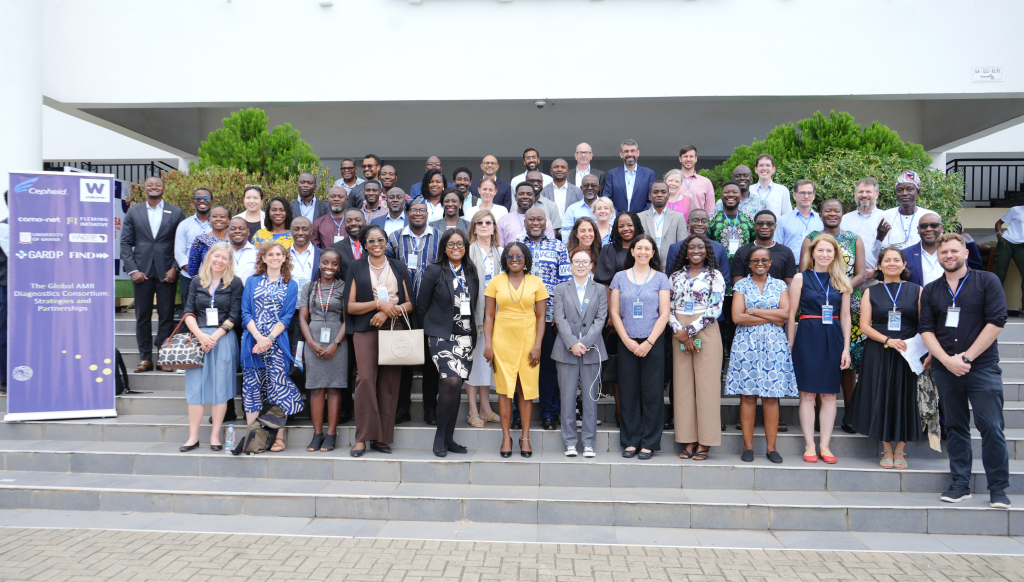
A global diagnostics collaborative
Background/overview
Antimicrobial resistance (AMR) poses a mounting threat to global health security. Effective diagnostics are vital for prevention, surveillance, case management, monitoring, and stewardship – yet they remain underfunded, underused, and inaccessible in many settings. Inappropriate or unnecessary antimicrobial use, often in the absence of diagnostic confirmation, accelerates the spread of resistance.
Recognising this critical gap, more than 90 stakeholders from government, academia, civil society, and industry convened in Accra, Ghana, in June 2025 to launch the DxAMR Collaborative. This global platform seeks to align and mobilise efforts, catalyse innovation, and accelerate access to diagnostics to address AMR, with a particular focus on low- and middle-income countries.
The DxAMR Collaborative is supported by the Fleming Initiative, WACCBIP at the University of Ghana, and CAMO-Net. Our launch in 2025 was supported by Wellcome Trust. Together, we are building a coordinated and sustainable response to AMR through equitable diagnostics access and implementation.

About DxAMR
The Mission
The mission of DxAMR is to improve equitable access to, and the effective use of, diagnostics for AMR through advocacy, awareness raising, evidence generation, and coordination. The Collaborative seeks to make diagnostics a fundamental pillar of AMR strategies, strengthening treatment, surveillance, and infection prevention while supporting universal health coverage and global health security.
The Goal
The goal of DxAMR is to serve as a convening platform for diverse stakeholders to:
- Advocate for stronger diagnostic capacity and stewardship;
- Harmonise and align diagnostic development, access, and implementation efforts across sectors;
- Drive coordinated action towards the integration of diagnostics into AMR policy, practice, and national action plans.
Objectives
DxAMR has five strategic priorities:
- Innovation and evidence generation – Accelerate the development and evaluation of fit-for-purpose diagnostics, particularly at the point of care in LMICs.
- Access and market shaping – Create sustainable and predictable markets to improve affordability, supply, and uptake.
- Economics and policy – Strengthen the economic case for diagnostics and engage Ministries of Finance and Health to embed diagnostics in budgets and action plans.
- Country readiness and capacity – Support diagnostic stewardship, laboratory networks, and integration with clinical services.
- Regulation and quality governance – Advance harmonised regulatory frameworks, quality standards, and regional capacity.
Membership
Membership of DxAMR consists of organisational representatives, not individuals, from:
- Government agencies and public health institutes
- Multilateral and intergovernmental organisations
- Nongovernmental organisations and civil society groups
- Academic and research institutions
- Private sector and industry associations
- Philanthropic foundations and funding partners
Members are expected to contribute to the advancement of public health and DxAMR’s mission, demonstrate active involvement in diagnostics for AMR, and align with the principles of equity, transparency, and co-operation.


Governance
The Collaborative is led by an inaugural organising committee coordinated by the Fleming Initiative and supported by inaugural secretariat WACCBIP (The University of Ghana). A Steering Committee will be established to provide overall strategic direction, with membership drawn from a balanced group of stakeholders across regions, sectors, and disciplines.
The University of Ghana, our inaugural secretariat, supports operations, coordination, and communication, ensuring the Collaborative remains inclusive, transparent, and impact-driven.
Voices from the DxAMR Collaborative
Meet the people driving innovation and collaboration in diagnostic access for AMR — from researchers and policymakers to frontline practitioners.
Join our mailing list
If you would like to join our mailing list to find our more about this exciting new project, please enter your email below.